



How Much Does Hail Damage Repair Cost in Colorado Springs?
Hail damage can range from a few small dents to hundreds of impacts across the roof, hood, trunk and sides of a vehicle. That makes one of the most common questions we hear at Dentagon difficult to answer without seeing the vehicle:
How much does hail damage repair actually cost?
The short answer is that there is no standard price for auto hail damage repair. The cost depends on the number and severity of the dents, which panels were damaged, the materials those panels are made from, accessibility to the damaged areas and whether Paintless Dent Repair (PDR) is appropriate.
If your vehicle was damaged by hail in Colorado Springs, the best place to start is with a professional inspection. Dentagon offers free hail damage inspections so you can understand the extent of the damage and your repair options before moving forward.
LEARN MORE ABOUT HAIL DAMAGE REPAIR
What Determines the Cost of Hail Damage Repair?
Unlike repairing a single door ding, hail damage often involves dozens or even hundreds of dents distributed across several panels.
A professional hail damage estimate considers much more than simply counting visible dents.
Factors that can affect the cost include:
- Number of hail dents
- Size and depth of the dents
- Number of damaged panels
- Location of the dents
- Dents located on body lines
- Steel versus aluminum panels
- Accessibility behind damaged panels
- Removal and installation of trim or interior components
- Condition of the vehicle’s factory paint
- Previous body or paint repairs
Two vehicles parked next to each other during the same Colorado hailstorm can therefore have very different repair estimates.
How Are Hail Dents Typically Repaired?
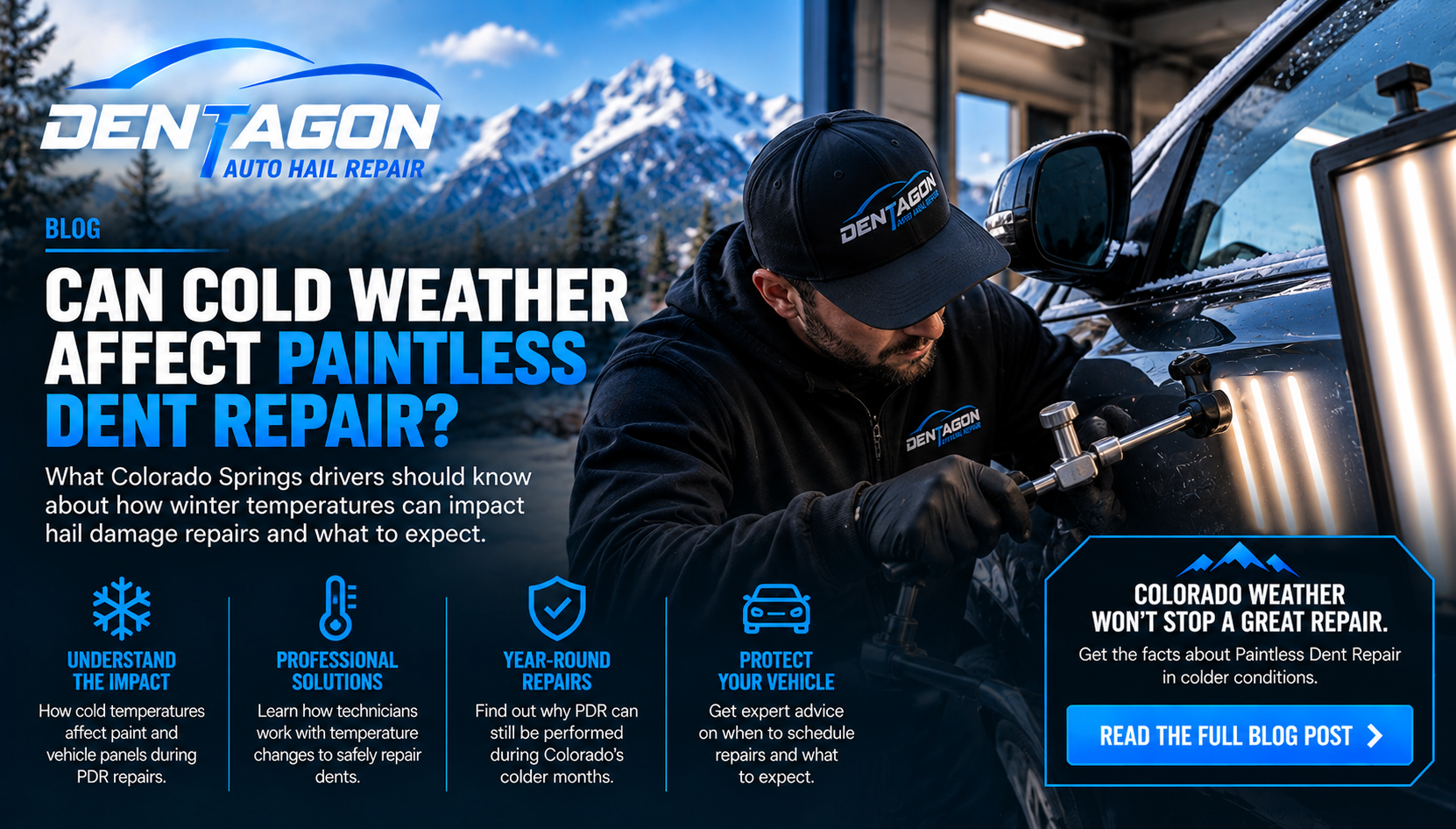
When the damage and paint condition are suitable, Dentagon uses Paintless Dent Repair (PDR) to repair hail dents.
PDR is a specialized repair method that allows trained technicians to carefully restore damaged metal without automatically sanding the panel, applying body filler or repainting it.
Specialized tools are used to access the backside of a damaged panel when possible and carefully manipulate the metal. Other PDR techniques may be used when backside access is limited.
One of the biggest advantages is preserving the vehicle’s existing factory paint whenever the damage is suitable for PDR.
LEARN MORE ABOUT PAINTLESS DENT REPAIR
Is Paintless Dent Repair Less Expensive Than Traditional Body Repair?
It can be, but cost shouldn’t be the only consideration.
Traditional collision repair may require sanding, body filler, primer, paint and blending adjacent panels. PDR avoids many of those procedures when the original paint remains intact and the metal can be successfully repaired.
However, not every hail dent is a candidate for PDR.
Cracked or severely damaged paint, significant metal stretching, previous body repairs or certain severe impacts may require conventional repair procedures.
Dentagon evaluates each affected panel and determines which repair method is appropriate rather than assuming every dent should be repaired the same way.
Why Does the Number of Dents Matter So Much?
Hail damage is generally more labor-intensive as the number of dents increases.
A hood containing 15 small dents requires a very different repair process than a hood containing 100 or more impacts of varying sizes.
Professional hail inspections commonly evaluate dents by panel, size and severity. That allows the repair facility to develop a much more accurate repair plan than simply looking at the vehicle outside.
Why Can Hail Damage Be Hard to See?
One reason customers are sometimes surprised by their repair estimate is that hail damage can be difficult to see under normal lighting.
A vehicle may appear to have only a handful of dents when viewed in a driveway or parking lot.
Professional PDR lighting and reflection systems make subtle distortions in the metal much easier to identify.
During an inspection, Dentagon examines the vehicle panel by panel rather than estimating the damage based only on the most obvious dents.
This can reveal hail damage on areas such as the:
- Hood
- Roof
- Trunk or liftgate
- Fenders
- Doors
- Quarter panels
- Roof rails
The actual extent of the damage may be considerably different from what you initially noticed.
Do Larger Hail Dents Cost More to Repair?
Dent size is one factor, but size alone doesn’t determine repair difficulty.
A relatively small dent located on a sharp body line may be more challenging than a larger shallow dent in an open section of a panel.
Technicians also consider the depth of the impact, metal stretch, access behind the panel and the condition of the paint.
That’s why accurately pricing hail damage from photographs alone can be difficult.
Does Aluminum Hail Damage Cost More to Repair?
Many newer vehicles use aluminum for hoods, liftgates and other body panels.
Aluminum behaves differently from steel and requires different PDR techniques. Repair complexity can therefore vary depending on the material and location of the damaged panel.
The presence of aluminum doesn’t automatically mean a panel needs to be replaced. Many aluminum panels can still be repaired with PDR when the damage is suitable.
What About Dents on Body Lines?
Body lines are the defined creases and contours designed into vehicle panels.
Hail impacts that strike these areas can be more technically challenging because the metal already has a specific shape and tension.
Many body-line dents can still be repaired with Paintless Dent Repair, but they require careful evaluation by an experienced technician.
Does Car Insurance Cover Hail Damage Repair?
Hail damage is generally associated with the comprehensive portion of an auto insurance policy, subject to the terms, deductible and limitations of the individual policy.
If you’re filing an insurance claim, your insurer may prepare an initial estimate for the damage.
That estimate is an important starting point, but it may not always represent the final repair cost.
LEARN ABOUT INSURANCE CLAIMS ASSISTANCE
What If the Insurance Estimate Is Lower Than the Actual Repair Cost?
This is where supplements can become part of the repair process.
Once a vehicle receives a detailed inspection or repair work begins, additional covered damage or necessary repair procedures may be identified that weren’t included in the original insurance estimate.
When appropriate, Dentagon can document those items and submit supplemental repair information to the insurance company for review.
Our Insurance Claims Assistance helps customers navigate the repair-related portions of this process without Dentagon making decisions about insurance coverage or policy benefits.
Do I Have to Use the Repair Shop My Insurance Company Recommends?
Your insurance company may provide a list of preferred or network repair facilities, but you retain the ability to choose your repair facility.
If you choose Dentagon, our team can communicate with the insurance company regarding repair-related estimates, documentation and supplements when necessary.
What About My Insurance Deductible?
Your deductible is the portion of a covered claim you’re generally responsible for under your insurance policy.
Dentagon offers up to $500 in Deductible Assistance on qualifying auto hail damage repairs.
Eligibility requirements and limitations apply, so the best approach is to have us inspect the vehicle and review the repair before assuming your vehicle qualifies.
LEARN ABOUT DEDUCTIBLE ASSISTANCE
Will I Need Transportation While My Vehicle Is Being Repaired?
Extensive hail damage can require your vehicle to remain at the repair facility while technicians work across multiple panels.
Dentagon offers Loaner Car Assistance for qualifying hail damage repairs, helping eligible customers stay mobile while their vehicle is being repaired.
Ask about transportation when scheduling your inspection so we can explain the available options and eligibility requirements.
LEARN ABOUT LOANER CAR ASSISTANCE
Can Dentagon Give Me a Hail Repair Price Over the Phone?
A rough conversation may be possible, but an accurate hail repair estimate generally requires inspecting the vehicle.
There are simply too many variables that aren’t visible over the phone—or even in photographs.
That’s why Dentagon offers a free professional hail damage inspection.
We’ll inspect the affected panels, evaluate whether PDR is appropriate and explain the repair process before you decide how to proceed.
Should I Repair Minor Hail Damage?
Don’t judge the extent of hail damage solely by what you can see outside.
What appears to be a few minor dents may be part of a much larger pattern of damage across the vehicle.
A professional inspection gives you better information before deciding whether repairing the vehicle makes sense.
Unrepaired hail damage can also affect the appearance of the vehicle and may influence its resale or trade-in value.
Why Choose Dentagon for Hail Damage Repair in Colorado Springs?
Dentagon specializes in auto hail damage repair and Paintless Dent Repair in Colorado Springs.
Our team can help with the entire repair-related process, including:
- Professional hail damage inspections
- Paintless Dent Repair
- Insurance Claims Assistance
- Supplemental repair documentation when necessary
- Up to $500 in Deductible Assistance on qualifying repairs
- Loaner Car Assistance for qualifying repairs
- Final repair quality inspection
Instead of guessing how much damage your vehicle has or what it might cost to repair, start by letting us inspect it.
SEE WHY COLORADO SPRINGS DRIVERS CHOOSE DENTAGON
Get a Free Hail Damage Inspection in Colorado Springs
If your car, truck or SUV was caught in a Colorado hailstorm, schedule a free hail damage inspection with Dentagon.
We’ll evaluate the damage, explain whether Paintless Dent Repair is appropriate and help you understand the next steps if insurance is involved.
SCHEDULE YOUR FREE HAIL DAMAGE INSPECTION